Key Takeaways
- AS9100 emphasizes process control and documented quality. Aerospace cleaning operations must meet applicable product, customer, and regulatory requirements.
- Nadcap requirements depend on the applicable special process. Cleaning may be evaluated as part of chemical processing, nondestructive testing, or another accredited process.
- Critical cleaning requires measurable acceptance criteria. Visual appearance alone may not establish whether a component meets its cleanliness specification.
- Ultrasonic technology reaches complex geometries. Cavitation helps remove contamination from blind holes, internal passages, threads, and difficult-to-access surfaces.
- Process repeatability supports validation. Controlled cleaning parameters make it easier to demonstrate consistent performance.
- Documentation is essential. Cleaning records, equipment monitoring, inspection results, and corrective actions help establish traceability and audit readiness.
Aerospace parts cleaning is more than removing visible contamination. For manufacturers, maintenance, repair, and overhaul (MRO) facilities, and precision component suppliers, cleaning is often a controlled manufacturing process that must deliver consistent, measurable, and documented results.
Aerospace ultrasonic cleaning offers a reliable approach to removing contaminants from complex components while supporting the process control, repeatability, and validation requirements associated with AS9100 and applicable Nadcap accreditation criteria.
What Is Critical Cleaning in Aerospace Manufacturing?
Critical cleaning in the aerospace industry refers to cleaning operations in which residual contamination could compromise component performance, manufacturing quality, inspection accuracy, or operational safety.
Unlike general-purpose cleaning, critical cleaning aerospace applications typically require defined acceptance criteria and a validated or otherwise qualified process capable of meeting them consistently.
Common aerospace contaminants include:
- Machining oils, cutting fluids, and lubricants
- Metal chips, fines, and abrasive particles
- Polishing and grinding compounds
- Carbon deposits and combustion residues
- Oxidation products and process chemicals
- Fingerprints, handling residues, and other organic contaminants
These contaminants can interfere with subsequent operations such as coating, bonding, plating, nondestructive inspection, and final assembly.
For example, residual machining fluid on a component intended for adhesive bonding may compromise surface preparation. Particulate contamination in a hydraulic component may contribute to premature wear or malfunction.
The appropriate cleaning method depends on the component material, geometry, contamination type, and required cleanliness level.
Understanding AS9100 Requirements for Aerospace Parts Cleaning
AS9100 is a quality management system standard for aviation, space, and defense organizations. It builds upon ISO 9001 with additional requirements addressing industry-specific quality and risk considerations.
AS9100 does not prescribe a universal cleaning method or cleanliness level. Instead, it requires organizations to establish and control the processes necessary to meet applicable product and customer requirements.
For aerospace parts cleaning, relevant considerations include:
- Process control: Establishing cleaning procedures, operating parameters, and acceptance criteria.
- Risk management: Identifying contamination risks that could affect product conformity or performance.
- Equipment maintenance and monitoring: Maintaining cleaning equipment and monitoring resources to support reliable operation.
- Traceability: Maintaining records linking cleaning operations to the appropriate parts, lots, or production orders when required.
- Verification and validation: Demonstrating that cleaning processes meet specified requirements, including validation where required.
- Nonconformance management: Identifying, documenting, and addressing parts that fail cleanliness requirements.
A well-controlled ultrasonic cleaning process can support these objectives by establishing repeatable operating conditions and measurable results.
Keep in mind, using ultrasonic equipment does not automatically establish AS9100 compliance. Compliance depends on the organization’s overall quality management system and the applicable process requirements.
How Nadcap Requirements Affect Aerospace Cleaning Operations
Nadcap is an industry-managed accreditation program administered by the Performance Review Institute (PRI). It evaluates special processes against applicable audit criteria and aerospace industry requirements.
Unlike AS9100, which addresses an organization’s quality management system, Nadcap focuses on the technical execution and control of specific manufacturing processes.
Cleaning requirements may arise within Nadcap-accredited operations involving chemical processing, nondestructive testing, or other special processes.
Depending on the applicable audit criteria and customer specifications, an aerospace cleaning operation may need to demonstrate:
- Documented cleaning procedures and approved process parameters
- Appropriate control of cleaning chemistry and bath conditions
- Equipment maintenance and calibration where applicable
- Operator training and qualification
- Defined inspection and acceptance methods
- Process records and corrective action procedures
Nadcap does not establish one universal ultrasonic cleaning specification for every aerospace component. Requirements must be determined from the relevant process audit criteria, customer specifications, and engineering documentation.
For facilities pursuing or maintaining accreditation, the ability to demonstrate consistent cleaning performance can be as important as the cleaning results themselves.
Establishing Acceptable Cleanliness Levels for Aerospace Components
One of the most important questions in aerospace parts cleaning is: How clean is clean enough?
There is no single cleanliness threshold appropriate for every aerospace application. Acceptance criteria depend on the component’s function, the next manufacturing operation, and applicable customer or engineering requirements.
Common cleanliness verification methods include:
Visual Inspection
Used to identify visible residues, staining, corrosion, or remaining debris. Visual inspection is useful but may not detect microscopic particles or thin films of contamination.
Particle Contamination Analysis
Particles can be extracted from cleaned components and evaluated for particle count, size distribution, mass, or other specified characteristics.
Nonvolatile Residue (NVR) Testing
Measures residue remaining after an extraction solvent evaporates. NVR testing can help evaluate residual oils, greases, and other soluble contamination.
Surface Cleanliness Testing
Depending on the application, methods such as water-break testing or other surface analysis techniques may help assess contamination that could affect coating or bonding operations.
Application-Specific Cleanliness Standards
Some aerospace components are subject to customer-defined limits or industry cleanliness classification systems. For example, NAS 1638 may be referenced for fluid contamination classification, although its use and applicability depend on the specific requirement.
The key is to define measurable acceptance criteria before selecting or validating the cleaning process.
How Aerospace Ultrasonic Cleaning Supports Process Validation
Ultrasonic cleaning uses high-frequency sound waves transmitted through a liquid cleaning solution. These waves produce cavitation, the formation and collapse of microscopic bubbles that help dislodge contamination from component surfaces.
This mechanism is particularly useful for aerospace components with intricate geometries that are difficult to clean using conventional spray or manual methods.
Examples include turbine components, precision-machined housings, valves, fittings, hydraulic components, and complex assemblies, provided the process is compatible with the materials and construction.
Controlling Critical Cleaning Parameters
For repeatable results, an ultrasonic cleaning process should establish and monitor appropriate operating conditions.
Important parameters include:
- Ultrasonic frequency and power settings
- Cleaning solution chemistry and concentration
- Bath temperature
- Cleaning cycle duration
- Component positioning and loading configuration
- Solution condition and replacement intervals
- Rinsing and drying procedures
Changes to these variables can affect cleaning effectiveness.
For example, overcrowding a cleaning tank can reduce exposure to ultrasonic energy, while inadequate rinsing may leave detergent residue on otherwise clean parts.
Documented operating limits help facilities maintain consistency between cleaning cycles and production shifts.
Validating the Cleaning Process
A cleaning validation or qualification program should demonstrate that the selected process consistently meets defined cleanliness requirements.
Depending on customer requirements and process risk, this may involve:
- Defining acceptance criteria: Identify allowable contamination levels and required inspection methods.
- Establishing process parameters: Document cleaning chemistry, ultrasonic settings, temperature, cycle time, and other critical variables.
- Conducting qualification trials: Evaluate representative components, contamination conditions, and production loading arrangements.
- Verifying results: Use appropriate cleanliness testing to determine whether acceptance criteria are met.
- Documenting findings: Retain approved procedures, test results, equipment settings, and qualification records.
- Monitoring ongoing performance: Establish routine checks and criteria for requalification when significant process changes occur.
The objective is to create a repeatable process supported by objective evidence, rather than relying on visual inspection or operator judgment alone.
Documentation and Traceability for Aerospace Cleaning Audits
Effective documentation connects the cleaning process to the component and provides evidence that required procedures were followed.
Depending on the application, records may include:
- Part number, lot number, or serial number
- Cleaning procedure and revision level
- Cleaning equipment identification
- Cycle parameters and processing date
- Cleaning solution monitoring results
- Operator identification
- Inspection and cleanliness test results
- Deviations, corrective actions, and reprocessing records
Automated equipment monitoring and data collection can reduce manual recording requirements and improve consistency.
The required level of documentation should always be established by the applicable customer, quality system, and special-process requirements.
Selecting Ultrasonic Cleaning Equipment for Aerospace Applications
Choosing an ultrasonic cleaning system requires more than determining tank size or ultrasonic frequency. Facilities should evaluate part geometry, material compatibility, contamination type, throughput, cleanliness specifications, and documentation requirements. For demanding applications, a multistage process incorporating ultrasonic cleaning, rinsing, and controlled drying may be appropriate.
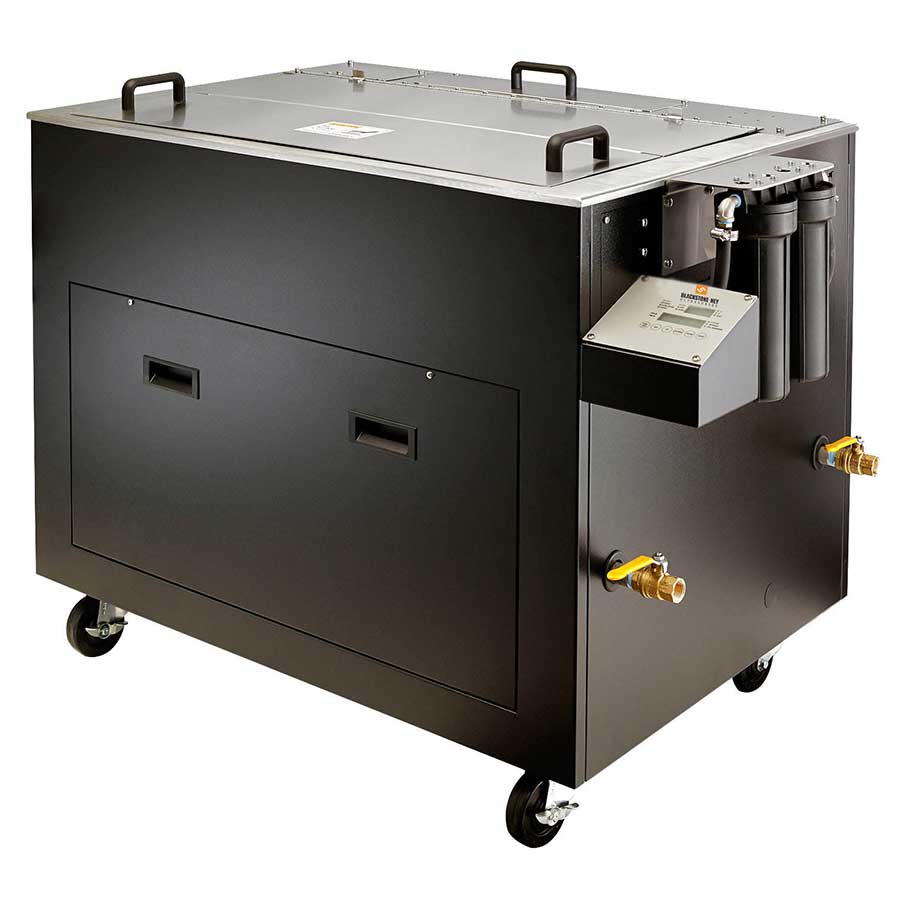
Blackstone-NEY develops industrial ultrasonic cleaning equipment for precision cleaning applications, including systems designed around specific component and process requirements. Our engineering team can help evaluate cleaning challenges, identify suitable ultrasonic configurations, and determine which process controls and equipment features support your organization’s cleaning objectives.
For aerospace manufacturers and MRO operations, this application-focused approach helps align cleaning equipment selection with production requirements and established quality procedures.
Build a More Consistent, Documented Aerospace Cleaning Process
Successful aerospace parts cleaning requires the right combination of cleaning technology, process controls, cleanliness verification, and documentation. Ultrasonic technology can play an important role by providing effective cleaning for complex components while supporting the repeatability necessary for controlled manufacturing environments.
Whether you are developing a new cleaning process, replacing aging equipment, or preparing for customer and accreditation audits, selecting the appropriate system is an important step toward reliable cleaning performance.
Contact the Blackstone-NEY team to discuss your aerospace parts cleaning requirements and explore ultrasonic cleaning solutions designed for your application.