Key Takeaways
- Industrial ultrasonic cleaners and aqueous spray washers each excel in different manufacturing environments and cleaning applications.
- Part geometry, contamination type, cleanliness specifications, and production volume should drive your equipment selection, not purchase price alone.
- Ultrasonic cleaning equipment is the preferred solution for precision components with blind holes, internal passages, and intricate features.
- Spray washers are often the best choice for high-volume production of larger, less complex parts with easily accessible surfaces.
- Manufacturers in aerospace, medical, electronics, and other regulated industries frequently require the repeatable, validated cleaning provided by precision cleaning equipment.
- Evaluating your cleaning process with an experienced equipment partner can help ensure long-term performance, compliance, and return on investment.
Choosing the Right Cleaning Technology Starts with Your Parts
When manufacturers begin evaluating a new parts cleaning system, one question often arises:
Should we invest in an industrial ultrasonic cleaner or an aqueous spray washer?
Both technologies are widely used throughout manufacturing and both can deliver excellent results when matched to the right application. However, ultrasonic cleaning systems and aqueous spray washers operate very differently and are designed to solve different cleaning challenges.
Selecting the wrong system can lead to inconsistent cleanliness, unnecessary labor, increased operating costs, or even rejected parts during customer inspection.
The right solution depends on several factors, including:
- The type of contamination being removed
- The geometry of the parts
- Production throughput requirements
- Industry cleanliness standards and validation requirements
Understanding these differences makes it much easier to select cleaning equipment that supports both today’s production needs and tomorrow’s quality expectations.
Industrial Ultrasonic Cleaner vs. Aqueous Spray Washer: A Quick Comparison
| Consideration | Industrial Ultrasonic Cleaner | Aqueous Spray Washer |
|---|---|---|
| Cleaning Method | Ultrasonic cavitation | High-pressure spray impingement |
| Complex Part Geometry | Excellent | Limited |
| Blind Holes & Internal Passages | Excellent | Poor to Fair |
| Heavy Surface Soils | Good to Excellent | Excellent |
| Delicate Components | Excellent | Good |
| High Production Throughput | Good | Excellent |
| Precision Cleaning | Excellent | Good |
| Cleaning Validation | Excellent | Good |
While both systems use aqueous cleaning solutions, their cleaning mechanisms produce very different results.
How Industrial Ultrasonic Cleaning Equipment Works
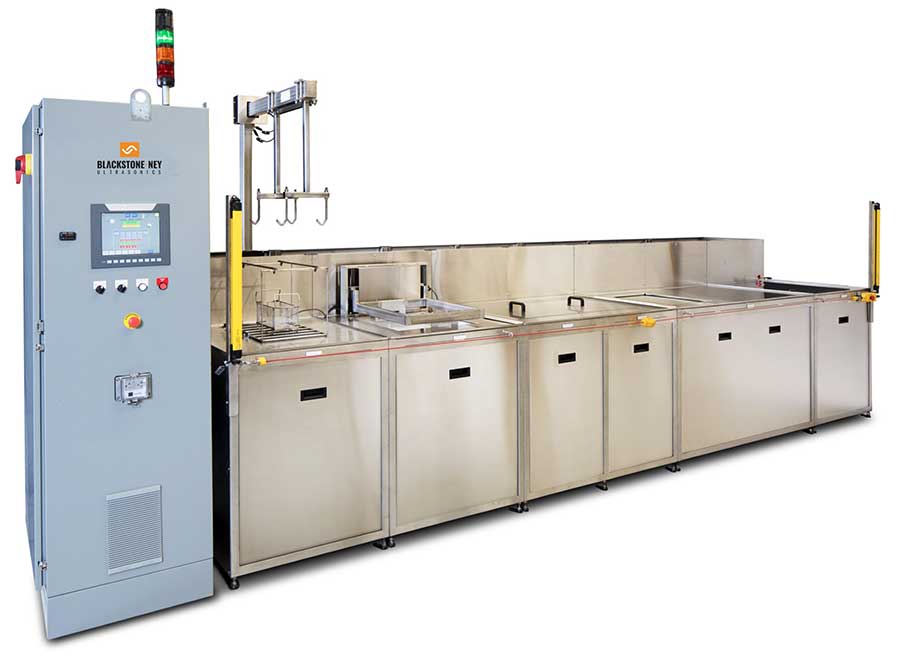
An industrial ultrasonic cleaner uses high-frequency sound waves transmitted through a cleaning solution to create microscopic cavitation bubbles. As these bubbles rapidly form and collapse, they generate tiny cleaning forces that remove contaminants from virtually every exposed surface.
Unlike spray systems, ultrasonic cleaning does not rely on direct line-of-sight contact.
Instead, the cleaning action reaches:
- Blind holes
- Internal channels
- Threaded features
- Small crevices
- Fine surface textures
- Complex machined geometries
This makes ultrasonic cleaning equipment especially valuable when parts have intricate designs or strict cleanliness requirements.
How Aqueous Spray Washers Clean Parts
Aqueous spray washers clean by directing heated cleaning solution onto parts through strategically positioned spray nozzles.
The combination of pressure, chemistry, temperature, and mechanical impact effectively removes contaminants from exposed surfaces.
Spray washers are commonly used for:
- Large fabricated components
- Castings
- Stampings
- Engine components
- Heavy grease removal
- High-volume manufacturing
When contamination is located primarily on open surfaces, spray washing can provide fast and efficient cleaning with excellent throughput.
Contamination Type Plays a Major Role in Selection
Different contaminants often favor different cleaning technologies.
When Industrial Ultrasonic Cleaners Perform Best
- Fine machining chips
- Metal fines
- Polishing compounds
- Buffing residue
- Light oils
- Flux residues
- Precision particulate contamination
The microscopic cavitation action can dislodge contaminants trapped inside features that mechanical spray simply cannot reach.
When Spray Washers Excel
- Heavy grease
- Thick machining oils
- Large chips
- Carbon buildup
- Surface dirt
- Bulk contamination
For heavily soiled components with simple geometries, spray impingement provides excellent cleaning efficiency.
Part Geometry Often Determines the Best Cleaning Solution
Perhaps the single biggest factor in choosing between these technologies is the shape of the part itself. Simple components with open surfaces are often cleaned successfully using spray washing.
Examples include:
- Brackets
- Housings
- Frames
- Large machined plates
- Weldments
However, today’s manufactured components are becoming increasingly complex. Medical devices, aerospace components, electronics, hydraulic manifolds, fuel system components, and precision machined parts often contain features that are impossible for spray nozzles to reach consistently.
Examples include:
- Cross-drilled holes
- Internal passages
- Threaded ports
- Cooling channels
- Narrow slots
- Complex assemblies
For these applications, precision cleaning equipment using ultrasonic technology typically produces significantly more consistent results.
Throughput vs. Cleanliness: Finding the Right Balance
Production speed is another important consideration.
Spray Washers Are Ideal When
- Very high production volumes are required
- Parts are relatively simple
- Continuous conveyor systems are preferred
- Cycle time is the primary objective
Ultrasonic Cleaning Equipment Is Ideal When
- Cleanliness requirements are extremely demanding
- Quality outweighs maximum throughput
- Parts require multiple cleaning stages
- Validation and repeatability are critical
Many manufacturers ultimately discover that maximizing throughput provides little value if contamination leads to rework or rejected parts downstream.
Regulatory Requirements May Influence Your Decision
Manufacturers serving highly regulated industries often need more than clean-looking parts. They need documented, repeatable cleaning performance.
Industries commonly requiring validated cleaning processes include:
- Aerospace and defense
- Medical device manufacturing
- Electronics and PCB production
- Optics
- Semiconductor manufacturing
- Precision machining
Depending on the application, manufacturers may need to demonstrate quality systems and compliance with standards such as:
- AS9100
- ISO 13485
- FDA quality requirements
- IPC cleanliness guidelines
In these environments, precision cleaning equipment capable of producing repeatable results often becomes a necessity rather than a preference.
Which Cleaning Technology Is Right for Your Industry?
Aerospace
An industrial ultrasonic cleaner is often preferred for turbine components, hydraulic systems, fuel system parts, and precision-machined components where particulate contamination can affect performance.
Medical Devices
Ultrasonic cleaning equipment helps manufacturers clean implants, surgical instruments, and other complex devices that require validated cleaning processes.
Electronics
Printed circuit boards, connectors, sensors, and electronic assemblies frequently benefit from ultrasonic cleaning because delicate components can be cleaned without aggressive mechanical force.
Automotive Manufacturing
Both technologies are widely used. Spray washers often handle larger engine and drivetrain components, while ultrasonic systems clean fuel injectors, valve bodies, precision machined parts, and other critical assemblies.
General Industrial Manufacturing
The right choice depends on the complexity of the parts, production volume, and required cleanliness level.
Questions to Ask Before Choosing a Cleaning System
Before investing in new cleaning equipment, consider the following questions:
- What contaminants need to be removed?
- How complex are the parts?
- Are there blind holes or internal passages?
- What cleanliness specification must be achieved?
- Will customer audits require process validation?
- How important is throughput versus cleaning precision?
- Could future products require higher cleanliness standards?
Answering these questions early can prevent costly equipment changes later.
Finding the Right Precision Cleaning Equipment for Your Process
Every manufacturing process presents unique cleaning challenges. That is why selecting the right equipment involves more than comparing specifications.
Blackstone-NEY works with manufacturers to evaluate part geometry, contamination, production goals, and cleanliness requirements before recommending a solution. Our engineering team helps customers develop ultrasonic cleaning systems that deliver consistent, repeatable performance while supporting validation and regulatory compliance.
Whether you are replacing aging equipment, expanding production, or developing a new manufacturing process, we can help identify the cleaning technology that best fits your application.
Contact the Blackstone-NEY team today to discuss your parts, cleanliness requirements, and production goals. Together, we can help you select the industrial ultrasonic cleaner or precision cleaning equipment that delivers reliable performance for years to come.