Key Takeaways
- Lower ultrasonic frequencies create larger, more energetic cavitation bubbles and generally provide more aggressive cleaning.
- 25 kHz is well suited to robust parts and difficult contamination where aggressive cleaning action is beneficial.
- 40 kHz provides a balance between cleaning intensity and surface protection, making it a common choice for general industrial cleaning.
- 80 kHz produces smaller, less energetic cavitation bubbles and is better suited to delicate surfaces, precision components, and removal of smaller particles.
- Higher frequency is not automatically better. The correct ultrasonic cleaner frequency depends on the substrate, contamination, geometry, and required cleanliness.
- Applications involving multiple contaminant sizes or different part types may benefit from a multi-frequency ultrasonic cleaning process.
Choosing an ultrasonic cleaning system involves more than selecting tank size, power, and cleaning chemistry. One of the most important process variables is ultrasonic cleaner frequency.
Frequency affects the size and energy of the cavitation bubbles responsible for cleaning. As a result, the right frequency can depend on the material being cleaned, the type and size of contamination, surface requirements, part geometry, and the cleanliness specification the process must achieve.
For many industrial and precision cleaning applications, the practical decision comes down to three frequency ranges: approximately 25 kHz, 40 kHz, and 80 kHz.
What Does Ultrasonic Cleaner Frequency Actually Change?
The frequency of ultrasonic energy is measured in kilohertz (kHz). A 25 kHz system produces approximately 25,000 cycles per second, while an 80 kHz system produces approximately 80,000. Those differences change the behavior of cavitation.
During ultrasonic cleaning, alternating pressure waves create microscopic bubbles in the cleaning liquid. Those bubbles grow and ultimately implode, releasing energy near the surfaces of submerged parts.
At lower frequencies, cavitation bubbles tend to be larger and their implosions more energetic. As frequency increases, the bubbles become smaller and more numerous, with each individual implosion releasing less energy.
This produces a useful general rule:
- Lower frequency = larger bubbles and more aggressive cleaning
- Higher frequency = smaller bubbles and gentler, more precise cleaning
The distinction becomes especially important when choosing an ultrasonic frequency range for sensitive materials or stringent particulate cleanliness requirements.
When to Choose a 25 kHz Ultrasonic Cleaner Frequency
At 25 kHz, ultrasonic cleaning produces relatively large, energetic cavitation bubbles. That makes this frequency useful when the primary objective is removing stubborn contamination from durable parts.
Typical applications may include:
- Robust machined components
- Steel and other durable substrates
- Heavy oils and lubricants
- Buffing or polishing compounds
- Larger particles and debris
- Difficult industrial soils
The additional cavitation intensity can help break the bonds holding larger particles or stubborn contaminants to a surface.
There is a tradeoff. The same aggressive action that makes 25 kHz effective can increase the potential for surface damage on softer or more sensitive materials. Aluminum, brass, and other softer substrates may be more susceptible to cavitation erosion or “cavitation burning,” particularly with excessive exposure.
For that reason, 25 kHz should not simply be viewed as the “strongest” and therefore best option. Cleaning effectiveness has to be balanced against the mechanical strength and finish requirements of the part.
Why 40 kHz Is a Common General-Purpose Frequency of Ultrasonic Cleaning
Moving to 40 kHz reduces the size and energy of individual cavitation bubbles while increasing their number.
That balance makes 40 kHz a versatile frequency for many industrial cleaning processes.
Applications can include:
- General machined components
- Oils and manufacturing residues
- Moderately complex part geometries
- Components requiring effective cleaning without extremely aggressive cavitation
- Industrial parts with typical particulate contamination
For many applications, the performance difference between 25 and 40 kHz is more subtle than manufacturers might expect. Process variables such as time, temperature, chemistry, power, and part presentation can sometimes be adjusted to achieve successful results at either frequency.
That is why frequency should be evaluated as one component of the overall cleaning process rather than in isolation.
When Does an 80 kHz Ultrasonic Frequency Range Make Sense?
At approximately 80 kHz, cavitation bubbles are considerably smaller and their individual implosions are less energetic than those produced at 25 or 40 kHz.
This makes higher-frequency cleaning particularly useful when the objective shifts from removing heavy contamination to precision cleaning and smaller-particle removal.
Applications can include:
- Electronics and microelectronics
- Medical components
- Precision optics
- Delicate assemblies
- Parts with sensitive surfaces
- Components subject to stringent particulate cleanliness requirements
Higher frequencies offer another advantage for small-particle removal. Smaller cavitation bubbles can operate closer to a part’s surface, helping the cleaning action reach particles that lower-frequency cavitation may have difficulty attacking effectively.
The result is not simply “less aggressive” cleaning. It is a different type of cleaning action that can be better suited to precision applications.
25 kHz vs. 40 kHz vs. 80 kHz: A Practical Comparison
| Frequency | Cleaning Character | Often Best Suited For | Key Consideration |
|---|---|---|---|
| 25 kHz | Most aggressive of the three | Robust parts, stubborn soils, larger particles | Greater potential for damage to softer or delicate surfaces |
| 40 kHz | Balanced, general-purpose cleaning | Machined components, oils, residues, general industrial cleaning | Versatile starting point for many applications |
| 80 kHz | Gentler, precision-oriented cleaning | Delicate components, smaller particles, sensitive surfaces | Better suited to critical cleaning than heavy soil removal |
These guidelines are useful for narrowing the choices, but frequency alone does not determine whether a cleaning process will meet specification.
Material and Contamination Should Be Evaluated Together
One common mistake is choosing frequency based only on the material being cleaned. A better approach is to consider the substrate and contamination together.
A robust steel component covered with difficult residue may benefit from lower-frequency cavitation. A precision component carrying fine particulate contamination may require a higher frequency, even if the substrate itself could withstand more aggressive cleaning.
Engineers should consider:
- Substrate material and hardness
- Surface finish
- Particle size
- Soluble versus insoluble contamination
- Soil adhesion
- Blind holes and complex geometry
- Required cleanliness level
- Acceptable risk of surface alteration
Cleaning chemistry, temperature, exposure time, ultrasonic power, rinsing, and drying also influence the final result.
What If One Ultrasonic Frequency Is Not Enough?
Some cleaning challenges do not fit neatly into a single frequency category. A component might carry both larger particles requiring substantial cavitation energy and very small particles requiring higher-frequency cleaning. A facility may also need to process multiple product families with substantially different cleaning requirements. Multi-frequency technology provides another option.
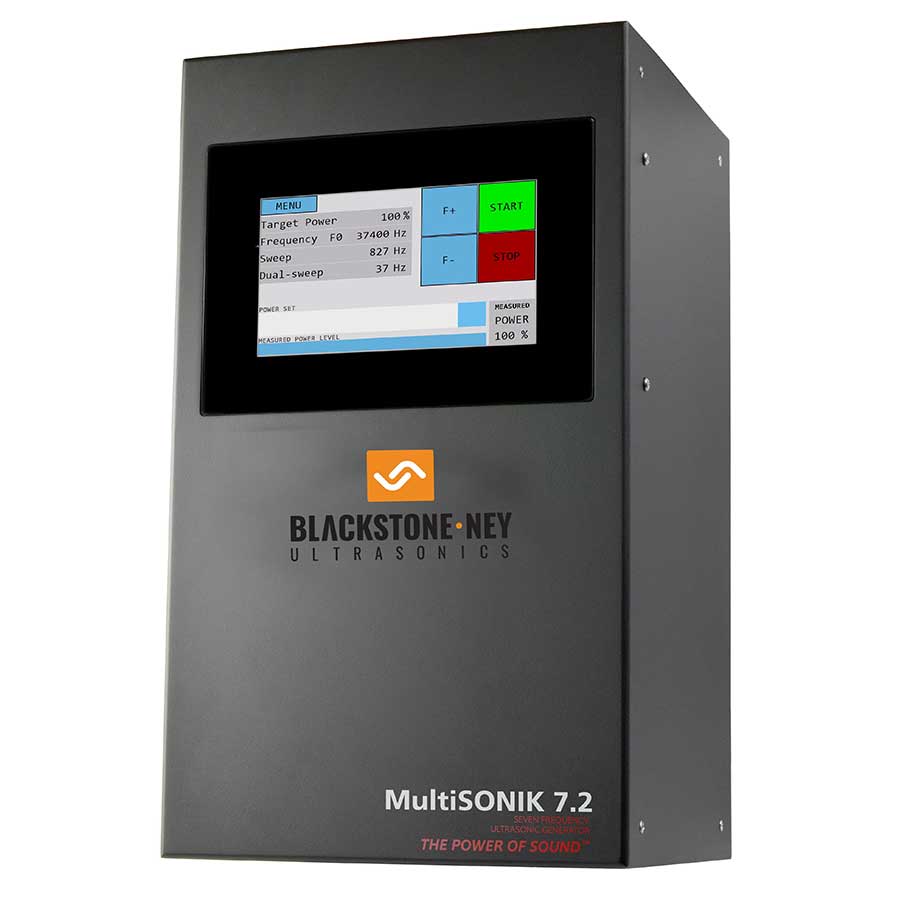
Blackstone-NEY’s multiSONIK® ultrasonic generators allow users to select and program single or multiple frequencies within a process tank. Available frequencies include 40, 80, 120, 140, 170, 220, and 270 kHz on the multiSONIK®2 platform, while multiSONIK®3 provides 40, 72, and 104 kHz options.
This approach can be particularly valuable in critical cleaning applications where engineers need greater control over particle removal or need to accommodate different cleaning requirements without dedicating separate systems to every process.
Choose Frequency Based on the Cleaning Process, Not a Rule of Thumb
There is no universally correct frequency of ultrasonic cleaning.
- 25 kHz can provide aggressive cleaning for robust components
- 40 kHz offers a versatile balance for many industrial applications
- 80 kHz and higher frequencies can provide the more controlled cleaning action required for delicate surfaces and precision particulate removal
The best choice ultimately depends on the complete process.
For applications governed by demanding cleanliness specifications, validating the process with representative parts and contaminants is preferable to selecting equipment from frequency alone. The Blackstone-NEY team can evaluate your parts, contamination, cleanliness requirements, and production needs to help determine the appropriate frequency, power, chemistry, and system configuration.
Contact the Blackstone-NEY team to discuss your ultrasonic cleaning application and determine the right frequency strategy for your parts.