Overview Summary IPA and solvent-based ultrasonic cleaning can be highly effective, but only when safety and compliance are engineered into the system. Flammability, vapor control, and operator exposure are the primary safety risks that must be addressed. Regulatory considerations include OSHA, NFPA, EPA, and local fire code requirements. Proper enclosure, ventilation, and monitoring are critical … Continued
Overview Summary Console ultrasonic cleaning systems combine mechanical, chemical, thermal, and ultrasonic energy in a controlled chamber to achieve precision-level cleanliness. Transducer-driven cavitation is the core mechanism, creating microscopic scrubbing forces that remove residues traditional cleaning cannot reach. Multi-stage console design allows engineered sequences of wash, rinse, and dry stages for repeatable, specification-driven results. Filtration, … Continued
What Is an Ultrasonic Generator? An ultrasonic generator, sometimes referred to as the power supply, is the engine that drives the ultrasonic cleaning process. It converts standard electrical energy into the high-frequency electrical signals that power the transducers in an ultrasonic cleaner. These transducers then transform those signals into ultrasonic sound waves, creating the powerful … Continued
Precision cleaning is needed in a wide range of industries, however, not every facility has the space, throughput, or budget for large-scale cleaning systems. Small facilities, labs, and specialized production environments often face unique challenges, such as limited floor space, diverse cleaning requirements, and the need for consistent, repeatable results on delicate parts. Benchtop ultrasonic … Continued
Ensuring parts are impeccably clean can make or break production quality. But stubborn contaminants in blind holes or intricate crevices that traditional cleaning methods just don’t reach can lead to defects, rework, or even product failures. For those overseeing parts cleaning processes, immersible ultrasonic transducers offer a game-changing upgrade, transforming ordinary cleaning tanks into high-performance … Continued
In many manufacturing environments, cleaning needs don’t always stay in one place. Whether you’re working in a lab, servicing medical equipment, or maintaining components on the factory floor, having access to reliable and effective cleaning technology at the point of need is critical. Portable ultrasonic cleaners provide an effective and efficient solution for these applications. … Continued
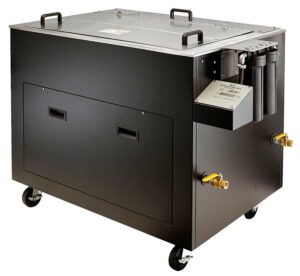
In industries like semiconductors, aerospace, medical devices, and electronics, precision is everything and there’s absolutely no room for contamination. Tiny particles, microscopic oils, or residual debris can cause critical failures, quality defects, or regulatory noncompliance. When it comes to cleaning small, delicate, or intricately shaped parts, ultrasonic cleaning has proven to be the gold standard … Continued
In most manufacturing processes, cleanliness isn’t just a preference, it’s a critical requirement that can impact everything from product performance to consumer safety. For components exposed to harsh environments, high heat, and complex machining, traditional cleaning methods often fall short. Industrial ultrasonic cleaners have proven to be an indispensable option for these heavy-duty applications across … Continued
Two important properties involved in parts cleaning are viscosity and surface tension. Understanding these concepts is useful for determining what cleaning methods will be most effective for an application. What is Viscosity? Viscosity is a physical characteristic of fluids that demonstrates resistance to motion or flow. Water is an example of a low viscosity (thin) … Continued

Medical device cleaning presents a unique set of challenges. Extremely rigorous cleaning standards are maintained for instruments used in surgery, medical and dental procedures, as well as devices used as medical implants. While these devices often have difficult to clean features like blind-holes and designed-in porosity, they also have the most stringent requirements for disinfection … Continued